
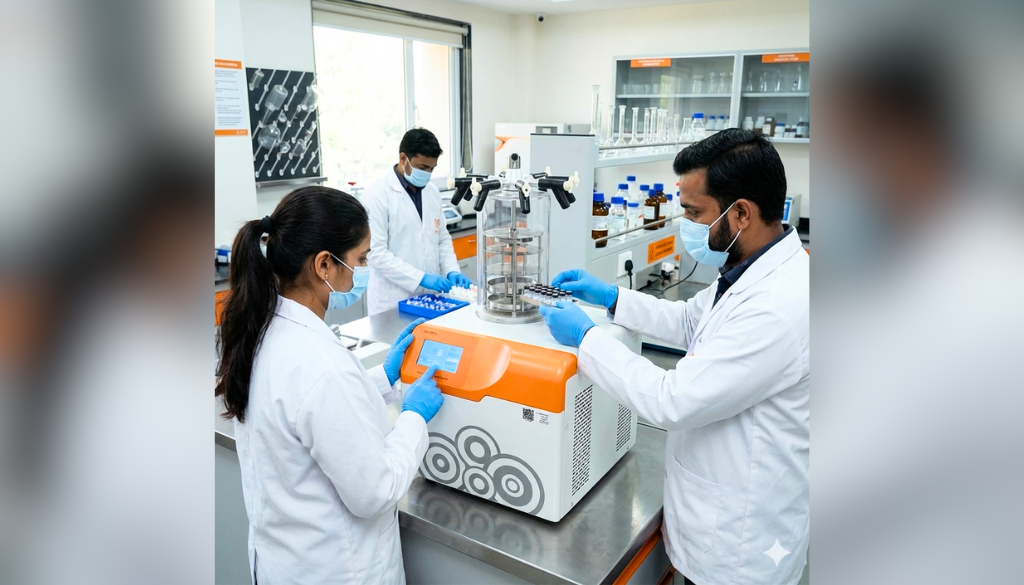
Lyophilization or freeze drying is one of the most crucial techniques of preservation used in biotechnology, pharmaceutical, and bio research industries. With increasing demand for long-lasting and stable therapeutics, lyophilization is an important step in the preservation of biological materials. This guide explores the science behind this technique, its benefits, stages, and applications as well as the technological advancements shaping the future.
Lyophilization is widely adopted by:
- Pharmaceutical manufacturing companies
- Biotechnology and life science research laboratories
- Vaccine development and production facilities
- Clinical diagnostics and molecular biology labs
- Gene therapy and advanced therapeutic developers
Lyophilization: Things to know
Lyophilization is a dehydration process that helps remove water from sensitive materials through sublimation. In other words, it’s like direct transition of ice into vapor without passing through the liquid phase. The process involves freezing, primary drying, and secondary drying stages and it improves shelf life, stability, and reconstitution efficiency.
Unlike traditional drying methods lyophilization techniques operate under low temperatures and reduced pressure, making it just right for preserving substances that are sensitive to heat such as proteins, vaccines, enzymes, cell cultures, and antibodies. Freeze drying minimizes thermal stress and oxidation and helps maintain the structural integrity, potency, and bioactivity of pharmaceutical and biological products.
| Parameter | Lyophilization Freeze Drying | Conventional Drying |
| Temperature | Low temperature processing | High temperature exposure |
| Pressure | Reduced vacuum conditions | Atmospheric pressure |
| Water Removal | Sublimation (ice to vapor) | Evaporation (liquid to vapor) |
| Suitability for Heat-Sensitive Materials | Excellent | Limited |
| Product Stability | Very high | Moderate |
Significance of Lyophilization
Pharmaceutical and biological materials often contain large amounts of water, making them prone to degradation, microbial contamination, and chemical instability. Removing water in significant amounts enhances product stability, extends shelf life, and supports long-distance transport without compromising efficacy.
Lyophilization is essential because it:
- Ensures long-term stability for sensitive therapeutics
- Preserves biological activity of proteins and living materials
- Improves product solubility and reconstitution time
- Reduces cold chain dependency and cuts storage and shipping costs
- Allows formulation of single-dose or multi-dose vials with consistent potency
As global demand for biologics and advanced therapeutics rises, freeze-drying is increasingly becoming the major framework of pharmaceutical manufacturing.
Stages of Lyophilization
Freeze drying takes place in multiple steps and is a highly controlled process. Each stage plays a crucial role in ensuring that the product remains safe, stable, and fully functional after rehydration.
1. Freezing
In this stage, the product is cooled below its glass transition temperature resulting in crystal structure formation. The aqueous phase transforms into solid ice.
Key goals of freezing:
- Create ice crystals of optimal size
- Maintain uniformity throughout the batch
- Prevent denaturation of sensitive components
Freezing is crucial because it defines the pathway for sublimation during the next stage. Too rapid freezing can create small crystals, slowing sublimation, while slow freezing may cause structural damage. Manufacturers often optimize freezing rates to ensure efficient drying without compromising structure.
2. Sublimation or Primary Drying
Primary drying begins once vacuum pressure is applied, allowing frozen water to sublimate. This is the longest and most energy-intensive stage.
Key factors:
- Low pressure facilitates sublimation
- Controlled heat input supports ice evaporation
- Shelf temperature must stay below collapse temperature
The goal is to remove approximately 90–95% of the water content while preserving the physical structure of the product. Any temperature spikes can cause product collapse, compromising stability.
3. Secondary Drying
After primary drying, residual water molecules remain adsorbed to the product. Secondary drying gently increases the temperature to remove this bound water.
Outcome:
- Final moisture content reduced to 1–5%
- Enhanced stability and longer shelf life
- Product ready for sealing and storage
This stage ensures that the final lyophilized material is sufficiently dry to remain stable even under ambient conditions.
Freeze Drying Equipment Used in Lyophilization
Lyophilization relies on advanced freeze drying equipment designed to precisely control temperature, pressure, and moisture throughout the drying cycle.
Key components include temperature-controlled drying chambers, high-efficiency vacuum pumps, condensers for ice vapor capture, and automated control systems for process validation.
Modern pharmaceutical freeze dryers support GMP compliance, batch consistency, and scalable production.
Key Application of Lyophilization
Lyophilization techniques are used in different sectors as they are best known for preserving biological and chemical integrity:
1. Vaccines and Biologics
Freeze-drying allows vaccines, especially live and attenuated ones to remain stable for months or years without refrigeration. This is vital for global immunization programs.
Monoclonal antibodies, recombinant proteins, peptides, and viral vectors are also routinely lyophilized to maintain activity during storage and distribution.
2. Antibiotics and Injectables
Many antibiotics, hormones, and other injectable drugs degrade quickly in solution. Lyophilization extends their usability and simplifies distribution, especially in remote areas lacking cold chain infrastructure.
3. Cell Culture and Enzymes
Lyophilization helps preserve:
- Enzymatic activity for biochemical assays
- Bacterial and fungal cultures
- Diagnostic reagents and PCR components
It ensures rapid reconstitution and consistent performance that is crucial for laboratories and point-of-care diagnostics.
4. Gene Therapy and Advanced Therapeutics
Emerging fields like mRNA therapeutics, plasmid DNA, and viral vector gene therapy heavily rely on freeze-drying for maintaining molecular stability.
Regulatory Importance of Lyophilization in Pharmaceutical Manufacturing
Properly validated freeze-drying cycles help ensure:
- Product sterility and safety
- Batch-to-batch consistency
- Long-term stability and compliance with regulatory expectations
These controls are essential for manufacturing vaccines, injectables, and biologics intended for global distribution.
Conclusion
Lyophilization is more than just a preservation method. It is a significant aspect of modern pharmaceutical and biological manufacturing. By ensuring stability, safety, and extended shelf life for sensitive therapeutics, it supports global healthcare delivery and the future of advanced medicines.
Are you ready to enhance the accuracy, reliability, and efficiency of your laboratory operations? Partner with IGene Labserve, your trusted provider of high-quality freeze drying equipment, biosafety solutions, and advanced scientific instruments. Visit IGene Labserve to upgrade your lab to the next level.
FAQs
Why is lyophilization used in pharmaceuticals?
It enhances stability, extends shelf life, and protects heat-sensitive drugs like vaccines, antibodies, and antibiotics.
Which products are commonly lyophilized?
Vaccines, biologics, antibiotics, enzymes, PCR reagents, and advanced therapeutics like mRNA and viral vectors.
Can lyophilized products be reconstituted quickly?
Yes, they quickly dissolve when mixed with the appropriate solvent.
What role does temperature control play in freeze drying technique?
Precise temperature control prevents product collapse and ensures efficient sublimation.