
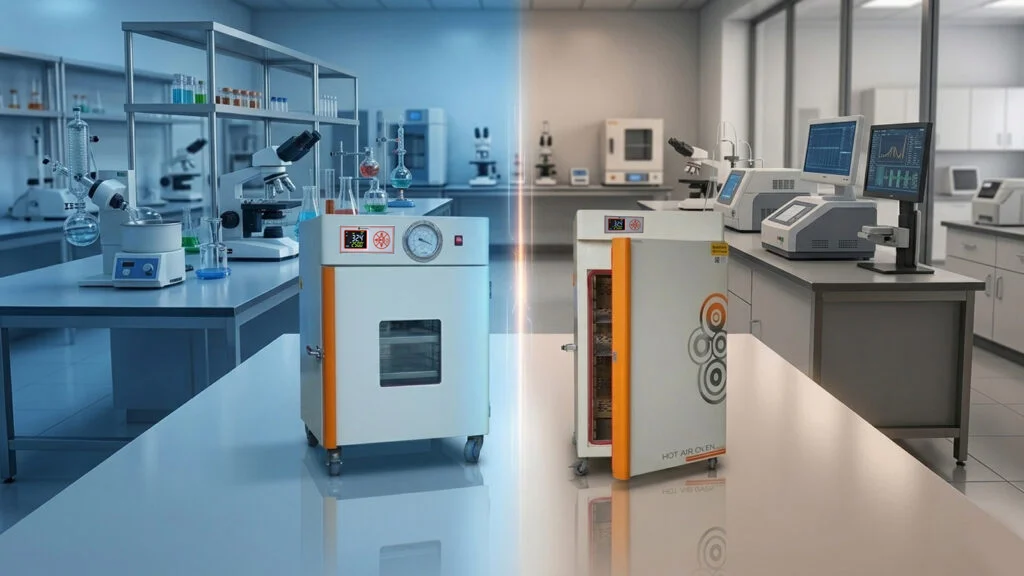
Ovens play a crucial role in research facilities, laboratories, and industrial settings for drying, curing, and heat treatment processes. However, when working with heat-sensitive samples, choosing the right equipment becomes important. Among the choices are vaccum ovens and hot air ovens. While both serve heating purposes, the operating principles and impacts on delicate samples differ to a great extent.
Understanding vacuum oven vs hot air oven helps ensure sample integrity, accuracy, and repeatability.
Table of Contents
Understanding Hot Air Oven
A hot air oven operates by circulating heated air evenly throughout the chamber. This convection-based system is widely used for sterilization, drying glassware, and general laboratory heating tasks. Temperatures typically range from 50°C to 300°C, making hot air ovens suitable for materials that can withstand prolonged exposure to heat.
Advantages of Hot Air Ovens
- Simple operation and maintenance
- Cost-effective and widely available
- Suitable for robust samples like glassware, metals, and powders

Limitations for Heat-Sensitive Samples
Despite their versatility, hot air ovens expose samples directly to oxygen at high temperatures. This can lead to oxidation, thermal degradation, moisture loss, or structural damage in sensitive materials such as polymers, pharmaceuticals, enzymes, or biological samples. Additionally, drying can be slower and uneven when moisture is trapped within the sample matrix.
Vacuum Air Oven: Things to Know
A vacuum oven removes air from the chamber and significantly lowers the atmospheric pressure. Under vacuum conditions, solvents and moisture evaporate at much lower temperatures. This allows drying and heating to occur gently, making vacuum ovens ideal for heat-sensitive, oxygen-sensitive, or volatile samples.
Vacuum ovens are commonly used in pharmaceutical research, electronics manufacturing, material science, and chemical laboratories.

Advantages of Vacuum Ovens
- Lower drying temperatures reduce thermal damage
- Minimal oxidation due to oxygen-free environment
- Faster and more uniform drying
- Ideal for solvents, resins, polymers, and delicate powders
Limitations
Vacuum ovens tend to be more expensive than hot air ovens and require additional components such as vacuum pumps. They may also have smaller chamber capacities compared to conventional hot air ovens.
Key Differences between Vacuum Ovens and Hot Air Ovens
Here are the differences to note:
1. Temperature Control
Vacuum ovens can dry samples at significantly lower temperatures, preserving molecular structure. Hot air ovens require higher temperatures to achieve similar drying results.
2. Oxygen Exposure
Vacuum ovens minimize oxidation by eliminating air, while hot air ovens continuously circulate oxygen-rich air, increasing the risk of sample degradation.
3. Drying Efficiency
Vacuum ovens remove moisture more efficiently, especially from porous or solvent-laden samples. Hot air ovens may require longer drying times, increasing heat exposure.
4. Sample Integrity
For delicate samples such as pharmaceuticals, biological materials, adhesives, or electronic components, vacuum ovens provide better protection against heat-induced damage.
Which Oven Is Better For Heat-Sensitive Samples?
When working with heat-sensitive samples, vacuum ovens are the better choice. Their ability to operate at reduced temperatures, prevent oxidation, and ensure uniform drying makes them ideal for preserving sample quality.
However, hot air ovens still have their place. If your samples are heat-stable, cost is a concern, or the application involves sterilization or drying of durable materials, a hot air oven is a practical and reliable option.
Conclusion
Choosing between a vacuum oven and a hot air oven depends largely on the nature of your samples. For heat-sensitive, oxygen-sensitive, or solvent-rich materials, vacuum ovens provide superior protection and efficiency.
Hot air ovens remain a cost-effective solution for routine, high-temperature applications involving durable materials. Ensure precision and protection for your sensitive samples with advanced laboratory solutions from iGene Labserve. Visit https://www.igenels.com/ to explore our collections.
FAQs
1. What is the main difference between a vacuum and hot air oven?
A vacuum oven removes air and operates under reduced pressure, allowing drying at lower temperatures, while a hot air oven uses circulating heated air to dry or heat samples at higher temperatures.
2. Can hot air ovens damage heat-sensitive samples?
Yes, prolonged exposure to high temperatures and oxygen in hot air ovens can lead to sample degradation, moisture loss, or structural damage in heat-sensitive materials.
3. When should a hot air oven be used instead of vacuum oven?
Hot air ovens are suitable for heat-stable applications such as glassware sterilization, metal components, and general laboratory drying where oxidation is not a concern.