
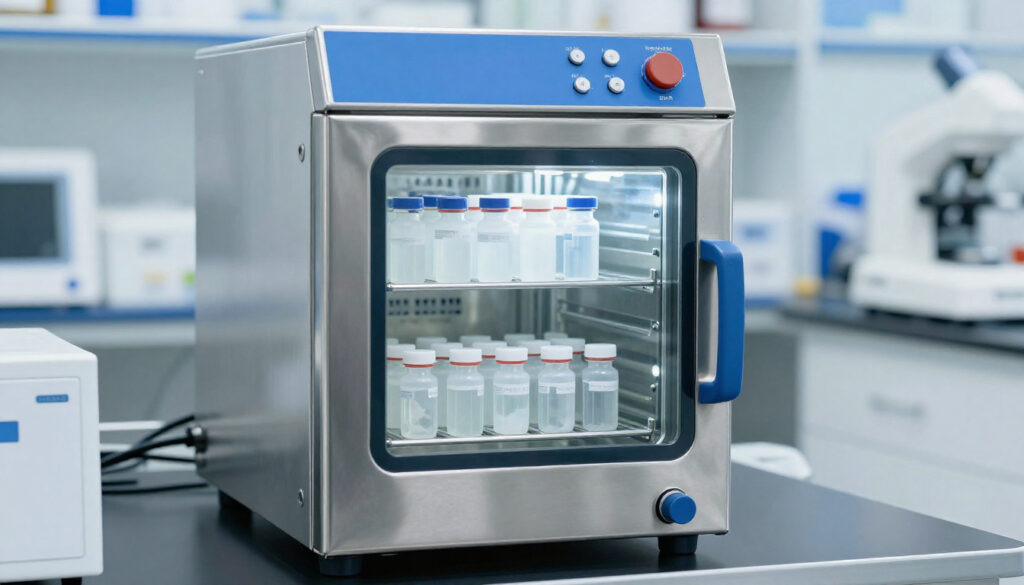
Choosing the right freeze drying technology is essential in modern laboratory environments where moisture removal, sample preservation, and product stability is crucial. wo of the most widely used techniques are freeze drying (lyophilization) and vacuum drying. Although both remove moisture under reduced pressure, they operate differently and are suited for different types of samples. Understanding how each process works — along with their strengths and limitations — will help you determine the best system for your lab.
If you’re wondering whether a freeze dryer or vacuum dryer is the better option, this guide will help you decide.
What is Freeze Drying?
Freeze drying, also called lyophilization, is a process where a sample is first frozen and then the ice is turned into vapor under low pressure. This gently removes moisture without using heat, so even very delicate samples stay stable and undamaged.
How the process works:
- Freezing – Sample is frozen below its eutectic point.
- Primary Drying (Sublimation) – Ice turns directly into vapor under low pressure.
- Secondary Drying – Residual moisture is removed for higher dryness levels.
Key Advantages of Freeze Dryer:
- Best for heat-sensitive samples because the process occurs at low temperatures.
- Preserves molecular structure, making it ideal for biological, pharmaceutical, and food samples.
- Results in extremely low moisture content.
- Produces porous and easy-to-rehydrate materials.
Common Applications:
- Vaccines and pharmaceuticals
- Enzymes, proteins, and probiotics
- Sensitive chemicals
- Long-term sample storage
- Food preservation and nutraceuticals
What is Vacuum Drying?
Vacuum drying removes moisture by reducing the chamber pressure so that liquids evaporate at much lower temperatures than under normal atmospheric conditions. Heat is applied — but at reduced temperature — making it suitable for moderately heat-sensitive materials and bulk drying.
How It Works:
- Chamber pressure is reduced using a vacuum system.
- Gentle heat is applied to evaporate moisture at a lower temperature.
- Vapor is removed through the vacuum line.
Key Advantages:
- Faster drying than freeze drying and many traditional methods.
- More energy-efficient and lower operational costs.
- Well-suited for bulk quantities or large materials.
- Protects samples that cannot tolerate high heat.
Common Applications:
- Chemicals, powders, and granules
- Pharmaceuticals with moderate heat sensitivity
- Polymers, resins, and compounds
- Heat-sensitive electronics
- Moisture removal from bulk solids
Freeze Dryer vs Vacuum Dryer — Which Should You Choose?
Both laboratory freeze dryers and vacuum dryers remove moisture under reduced pressure — but they are designed for very different sample needs. Use the comparison table below to quickly understand which system is best suited for your lab.
| Factor | Freeze Dryer (Lyophilizer) | Vacuum Dryer |
| Drying Method | Freezes samples and removes ice through sublimation under vacuum | Lowers pressure so moisture evaporates at a reduced boiling point with applied heat |
| Operating Temperature | Very low temperature | Low to moderate temperature |
| Heat Sensitivity Suitability | ⭐ Best for highly heat-sensitive samples | 👍 Suitable for moderately heat-sensitive samples |
| Moisture Removal Level | Extremely low final moisture content | Low to moderate residual moisture |
| Structural Preservation | Preserves molecular and structural integrity | Some structural change may occur |
| Drying Speed | Slow | Faster |
| Energy Consumption | Higher | Lower and more efficient |
| Batch / Bulk Suitability | Better for delicate, smaller-batch samples | Ideal for bulk powders, chemicals, and solids |
| End Product Texture | Porous, easy to rehydrate | Dense and dry |
| Typical Applications | Vaccines, proteins, probiotics, biological samples, nutraceuticals, research | Chemicals, powders, polymers, electronics, pharmaceuticals with moderate heat tolerance |
| Cost & Maintenance | Higher purchase and running cost | Lower cost and simpler operation |
Which Should You Choose?
Choose a Freeze Dryer if your priority is:
- Protecting fragile or heat-sensitive samples
- Achieving ultra-low moisture
- Maintaining sample structure
- Creating easily rehydratable material
Choose a Vacuum Dryer if your priority is:
- Faster drying
- Lower energy and operating cost
- Bulk processing
- Samples that tolerate low-to-moderate heat
Conclusion
Laboratory freeze dryers and vacuum dryers are indispensable tools in scientific and industrial laboratories but their strengths are very different. Freeze dryers offer unparalleled preservation for sensitive samples, while vacuum dryers provide speed and efficiency for general-purpose drying. Understanding the requirements of your workflow like temperature sensitivity, sample structure, moisture level, and throughput will guide you toward the right solution.
Whether your lab needs the precision of a freeze dryer or the efficiency of a vacuum dryer, IGene Labserve provides cutting-edge equipment designed for accuracy, reliability, and long-term performance. Visit https://www.igenels.com/ to explore our collections.
FAQs
Which dryer is better for heat-sensitive samples?
A freeze dryer is the best choice for highly heat-sensitive samples such as proteins, enzymes, vaccines, and biological materials, because drying occurs at very low temperatures.
When should I choose a vacuum dryer instead of freeze dryer?
Choose a vacuum dryer if your samples can handle low to moderate heat, you require faster drying, or you’re working with bulk solids, powders, chemicals, or materials where structural preservation is not critical.
Do either of these dryers work for bulk sample processing?
Vacuum dryers are better suited for bulk materials since they offer faster throughput and more efficient drying for large quantities.