
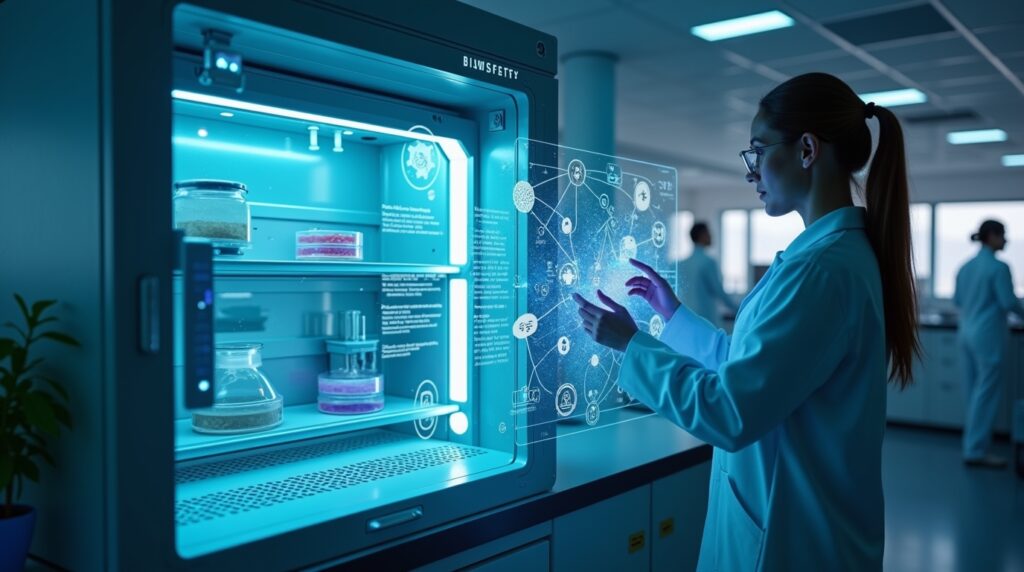
Biosafety cabinets play a crucial role in protecting researchers, samples and the environment from biological hazards. Traditionally, the design of BSCs was robust and mechanical where the HEPA filtration systems maintained safety. However, with the emergence of technologies like Artificial Intelligence and Internet of Things, the cabinets have evolved into intelligent and connected systems offering unprecedented levels of efficiency, safety, and control.
Here is how AI and IoT are transforming the biosafety cabinet in laboratories.
What are Biosafety Cabinets: Understanding the Classification
Biosafety cabinets are enclosed, ventilated laboratory workspaces designed to safely handle infectious or hazardous materials. They provide:
- Personal protection to the user
- Product protection to prevent contamination of the sample
- Environmental protection from exposure to harmful agents.
There are three primary classes of BSCs (I, II, and III). However, biosafety cabinet Class II is the most commonly used in biomedical labs, offering both product and personnel protection through a combination of airflow and HEPA filtration.
IoT integration in Biosafety Cabinets: Making Work Smarter
The Internet of Things (IoT) brings connectivity to equipment by embedding sensors and devices that collect and transmit real-time data. Here is how this technology may enhance a biosafety cabinet:
- Real-Time Monitoring
IoT-enabled BSCs use sensors to track airflow velocity, temperature, humidity, and pressure. These parameters are continuously monitored and can trigger alerts if conditions deviate from safe thresholds. - Remote Access & Control
Lab managers can remotely access BSC data via cloud dashboards or mobile apps, enabling off-site diagnostics, status checks, and performance reviews. - Predictive Maintenance
IoT sensors track fan speed, filter usage, and vibration levels to predict when the component may fail, allowing for preemptive maintenance that reduces downtime and repair costs. - Usage Analytics
Connected cabinets collect data on user activity, duration of use, and energy consumption needed for optimizing workflows and reducing operational costs.
How AI-Powered Intelligence Improves Monitoring And Decision Making?
While IoT collects data, AI is responsible for interpretation. So, here is how AI integration empowers biosafety cabinets class II:
- User Behavior Recognition
Cameras and motion sensors combined with AI algorithms detect unsafe actions like fast hand movements or objects blocking the airflow. The system can provide instant feedback via visual or audible alerts, improving training and reducing contamination risk. - Energy Optimization
AI can adjust fan speed and lighting based on occupancy or task type, helping to conserve energy without compromising safety. - Automated Compliance Reporting
Instead of manual logs, AI systems can generate digital compliance reports based on real-time usage data and simplify audits as well as regulatory inspections. - Anomaly Detection
AI can detect subtle deviations in airflow or equipment behavior that might go unnoticed by humans, indicating early warning signs of system failure.
Improved safety and compliance
With AI and IoT integration, biosafety cabinets are all set to become self-aware systems before any hazardous incident occurs. It enhances:
- Safety of laboratory personnel by minimizing risk exposure
- Integrity of samples by reducing contamination
- Regulatory compliance by ensuring consistent documentation and reporting
Conclusion
As laboratories grow increasingly complex and data-driven, AI and IoT-enabled biosafety cabinets offer a powerful edge. BSCs are transforming safety levels capable of adapting to their environment and users in real-time. Are you keen to order a biosafety cabinet for your research laboratory? At IGene Labserve, we don’t just supply lab equipment but deliver precision, innovation, and reliability to work smarter, safer, and more efficiently. Visit https://www.igenels.com/ to shop from our products.
FAQs
Here are a few common questions you may ask about biosafety cabinets:
Will smart biosafety cabinets be difficult to use?
No, most of them will have user-friendly interfaces making them easy to use for researchers and laboratory managers.
Is it worth upgrading to AI and IoT-enabled biosafety devices?
Yes, it is a long-term investment that will pay off with reduced downtime, minimized hazardous incidents, and reliable performance.
Can I access biosafety cabinet data remotely?
Yes, you can access data from BSC through cloud-based dashboards and mobile apps.