
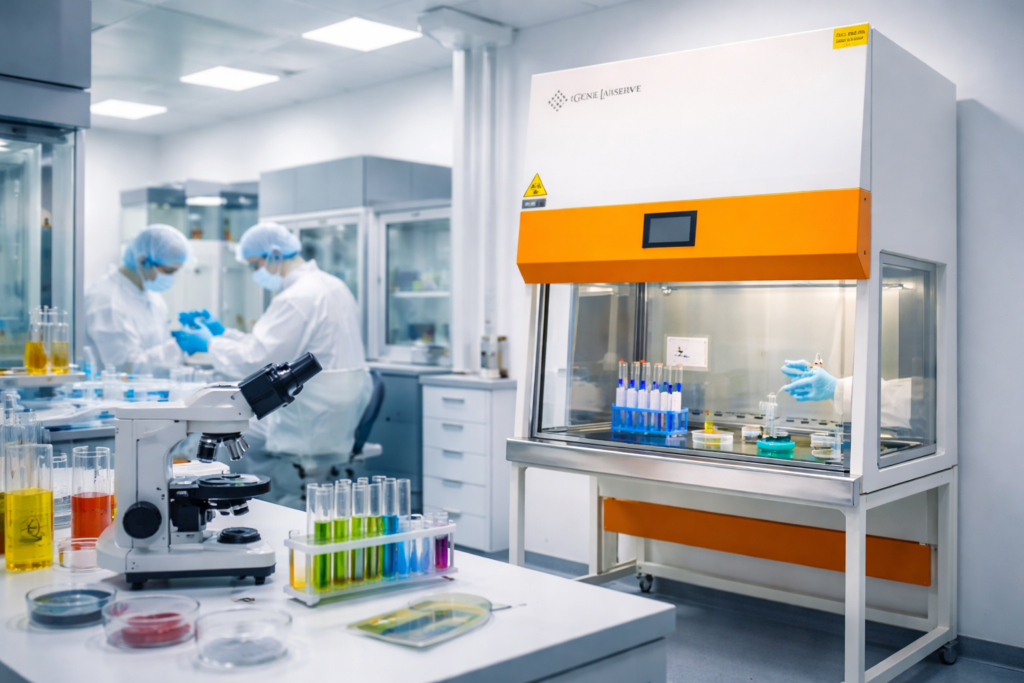
Biosafety Cabinets is the framework of safe laboratory operations wherever cell cultures, infectious agents, or other harmful chemical handling takes place. No wonder microbiology and pharmaceutical research to biotechnology and clinical diagnostics rely on these devices to protect the three most crucial elements – the product, the user, and the environment. However, simply owning a biosafety cabinet does not guarantee safety.
There are some non-negotiable factors that make this equipment truly safe for laboratory premises. Ignoring even one of them may compromise the safety and integrity of experiments, those conducting the experiments, and the environment.
Here are the most critical, non-negotiable factors that maximize safety levels in a biosafety cabinet for labs:
Table of Contents
Correct Cabinet Classification
BSCs have classifications and the first step is selecting the correct class and type when it comes to the types of biosafety levels. Here is what you need to know:
- Class I BSCs protect the user and the environment but not the product
- Class II BSCs provide protection to user, product and the environment that are commonly used in laboratories.
- Cass III BSCs offer maximum containment, are gas-tight, and usually needed for highly infectious agents.
Using the wrong class of a biosafety cabinet for your application may expose researchers to airborne pathogens, allow cross-contamination, and often release hazardous chemicals within the lab environment. The selection of cabinet must depend on risk assessment, biosafety level, and the materials handled in the laboratory.
High-Efficiency HEPA or ULPA filtration
Filtration is one of the primary requirements of BSCs. High-Efficiency Particulate Air (HEPA) filters remove 99.97% of particles as small as 0.3 microns, while ULPA filters go even further.
Non-negotiable filtration requirements include:
- Supply air HEPA filtration
- Exhaust air HEPA filtration
- Proper sealing and leak-free filter housing
A compromised filter or improper installation often allows pathogens to escape into the workspace or contaminate samples. Testing the integrity and functioning of the filter regularly is essential for maintaining safe airflow and containment.
Airflow
Ever wondered what is that invisible safety barrier present inside a biosafety cabinet? Well, it is the airflow systems that need to synchronize with each other to maximize safety levels.
- Inflow air velocity protects users by drawing contaminants into the cabinet
- Downflow laminar air safeguards the product by preventing cross-examination
A low airflow velocity allows contaminants to escape whereas high airflow velocity can disrupt sterile conditions. So, maintaining airflow performance is a non-negotiable safety aspect. Setting alarms to alert users about airflow changes is one way of tackling the situation.
Installation and Placement of the Cabinet
Even the best biosafety cabinet will fail if it is not installed incorrectly. Apart from this, placement within the laboratory also directly affects the performance.
Non-negotiable installation requirements include:
- Placement away from doors, air vents, and high-traffic zones
- Stable flooring and proper leveling
- Adequate clearance for exhaust and service access
Drafts, vibrations, or temperature fluctuations can destabilize airflow patterns and compromise containment. You must appoint trained professionals to handle cabinet installation.
Work Practices and Safety of Operators
Even the most advanced biosafety cabinet for labs cannot compensate for poor human practices. Therefore, proper operator behavior is a non-negotiable safety pillar.
The essential work practice rules include:
- Slow and controlled hand movements to avoid airflow disruption
- Blocking air grilles
- Only essential items placed inside the workspace
- Proper use of PPE such as gloves, lab coats, and face protection
- Correct aseptic techniques during handling
Untrained or careless operators can instantly compromise cabinet containment, regardless of design or certification.
Routine Maintenance and Preventive Servicing
A biosafety cabinet is a precision-engineered system that demands ongoing care. Preventive maintenance ensures that safety features continue functioning as designed.
Critical maintenance elements include:
- Motor and blower performance checks
- Electrical component inspection
- Alarm calibration
- UV light testing if it is installed
- Surface decontamination
Ignoring preventive maintenance can lead to silent failures and issues that remain undetected until exposure occurs.
Reliable Alarm and Monitoring Systems
Modern biosafety cabinets are equipped with real-time monitoring systems that continuously track airflow performance, filter loading, and sash position.
Non-negotiable alarm functions include:
- Audible and visual airflow alerts
- Filter clogging warnings
- Sash opening alarms
- Power failure notifications
These systems provide early warnings that prevent dangerous operating conditions before they escalate into real hazards.
Decontamination and Cleaning Protocols
Regular surface disinfection alone is not enough and cabinets must undergo full decontamination periodically, especially before:
- Filter replacement
- Relocation
- Major servicing
- Handling highly pathogenic materials
Without proper decontamination, hidden contamination may persist and pose risks long after experiments conclude.
Conclusion
Biosafety cabinets are not merely laboratory equipment but are life-saving containment systems. They protect scientists, preserve product integrity, and prevent environmental contamination. Hence, you need to comply with the above-mentioned factors to ensure functionality and integrity for years to come. Want to upgrade your lab with uncompromised safety and precision. Partner with IGene Labserve for NSF certified biosafety solutions. Contact us here IGene LabServe to safeguard your research.
FAQs
1. Why are biosafety cabinets essential in laboratories?
Biosafety cabinets play a crucial role in laboratories as they protect the user, the sample, and the environment from harmful contaminants and aerosols.
2. What is a common mistake that occurs when working with a BSC?
You must refrain from blocking the air grilles with hands, equipment, or materials.
3. Is UV light necessary inside the biosafety cabinet?
No, installing UV light is not essential inside a biosafety cabinet.
4.Can you relocate biosafety cabinets?
Yes, you can relocate BSCs but only with professional decontamination and re-certification.