
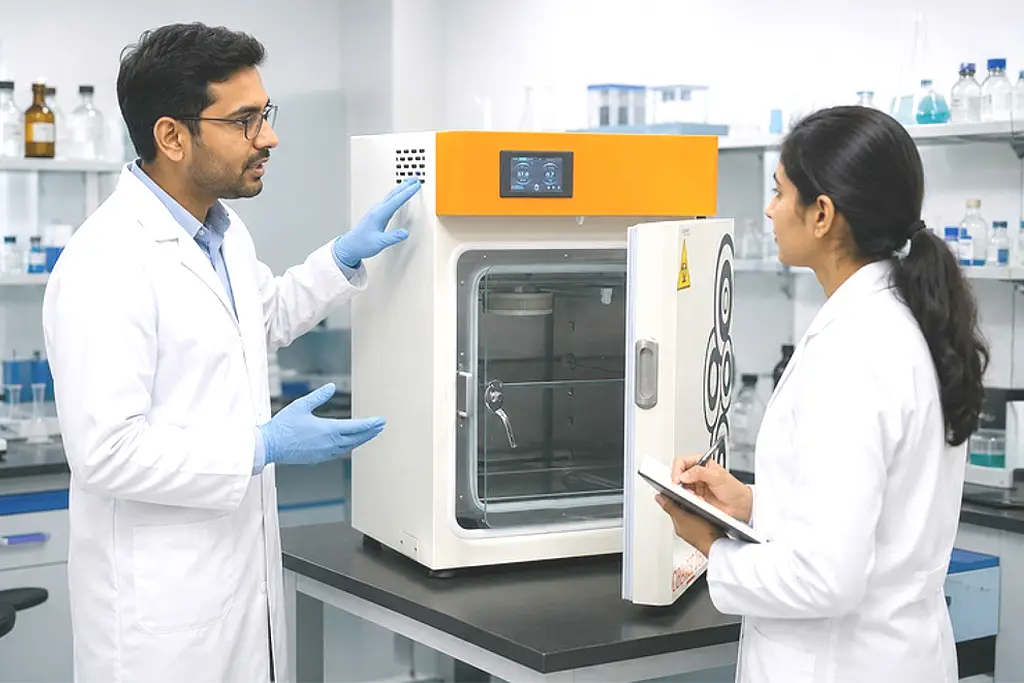
Are you searching for a CO2 incubator for cell culture, tissue engineering or pharmaceutical testing? Remember that choosing the right equipment impacts the accuracy and reproducibility of the results.
Following a CO2 incubator buying guide helps you explore the essential features, applications, and factors to consider before investing in the device. When you understand these aspects, it’s easier to choose equipment that supports your research and laboratory needs.
Why Choosing the Right Incubator Matters?
A CO2 incubator creates a controlled environment by maintaining stable temperature, humidity, and carbon dioxide levels. Even minor fluctuations can affect cell viability, growth rates, and experimental outcomes.
If you are wondering how to choose a CO2 incubator, the answer depends on research applications, contamination control requirements, workload in the laboratory, and long-term operational efficiency.
A high-quality carbon dioxide incubator for lab ensures:
- Stable and accurate CO2 measurement that remains unaffected by humidity or frequent door openings
- Maintains internal stability even with repeated access
- Offers advanced contamination control with ISO Class 5 HEPA filtration
- Has a user-centric design with touchscreen control, data logging, and multi-user access
- Is ideal for general cell culture and routine applications and advanced applications requiring precise control of CO2
- Has lower maintenance costs and offers better productivity
Make sure the equipment you buy has been quality checked.
Key CO2 Incubator Features to look for
1. 6-Side Heat Chamber
One of the most critical factors is maintaining temperature and humidity uniformity throughout the chamber. The 6-side heat chamber ensures that temperature distribution is uniform and offers six-sided heating.
The temperature field stabilizes at ±0.1°C, creating an ideal environment for cell tissue cultivation. Consistent environmental conditions are essential for sensitive tissue culture or cell culture applications.
2. Stainless Steel Interior
A polished stainless-steel chamber aids in easy cleaning. It also has rounded corners and removable stainless-steel shelves that makes maintenance easy and does not require any tools.
3. Versatile Sterilization Capacity
You can pick between UV sterilization and high heat sterilization at 140°C or 180°C. That way, you will get versatile equipment with flexible and powerful sterilization options for hygiene and safety.
4. Reliable CO2 Sensor Technology
The accuracy of carbon dioxide control depends largely on the sensor.
When comparing CO2 sensor (infrared vs. thermal conductivity) systems here is what you need to look into:
Infrared (IR) Sensors
- Highly accurate
- Minimizes errors from humidity or temperature fluctuations, especially in case of frequent door openings
- Faster recovery
- Less affected by humidity
- Ideal for continuous cell culture
Thermal Conductivity Sensors
- More economical
- Suitable for routine laboratory work
- Require periodic calibration
For research laboratories requiring maximum precision, infrared sensors are generally the preferred choice.
5. Heating Technology
Understanding water-jacketed vs. direct-heat incubator systems helps determine which model best fits your laboratory.
Water-Jacketed Incubators
Advantages:
- Excellent temperature stability
- Better protection during power interruptions
- Ideal for long-term cultures
Limitations:
- Higher maintenance
- Longer heating time
- Heavier design
Direct-Heat Incubators
Advantages:
- Faster temperature recovery
- Easier maintenance
- Lower operating costs
- Lightweight construction
These are suitable for laboratories with frequent door openings and routine daily use.
6. Prevention of Condensation
Check for heating elements around the front door and frame and eliminate condensation buildup on the chamber and glass door.
7. Energy Efficiency
The equipment must be optimized for lower gas and heat consumption, with faster recovery times and efficient management for various sample types.
8. LCD Touchscreen
A user-friendly touchscreen offers intuitive controls for settings, with audible/visual alarms, historical data display, and USB data export options.
Common Applications of CO2 Incubator
Understanding CO2 incubator features and applications helps laboratories match equipment with their research goals.
Typical applications include:
- Cell culture
- Stem cell research
- Cancer research
- Tissue engineering
- IVF laboratories
- Drug discovery
- Vaccine development
- Regenerative medicine
- Microbiology research
A reliable carbon dioxide incubator for cell culture provides the stable environment necessary for these demanding applications.
Conclusion
Selecting the right laboratory incubator goes beyond comparing specifications. The ideal solution should provide stable environmental conditions, reliable contamination control, efficient operation, and long-term durability. By understanding the key factors outlined in this CO2 incubator buying guide, laboratories can confidently choose equipment that supports accurate, reproducible, and high-quality research outcomes.
Are you looking for a high-performance CO2 incubator that delivers reliable environmental control and contamination-free cell culture conditions? iGene Labserve offers advanced CO2 incubators engineered for consistent temperature, humidity, and CO2 regulation to support. Visit https://www.igenels.com/ to explore our range of CO2 incubators.
Frequently Asked Questions
A CO2 incubator is used to maintain controlled temperature, humidity, and carbon dioxide levels for growing mammalian cells, tissues, and other biological samples under laboratory conditions.
Infrared sensors are generally more accurate, recover faster after door openings, and are less affected by humidity, making them ideal for advanced research applications.
Water-jacketed incubators offer excellent temperature stability and protection during power outages, while direct-heat models provide faster recovery, easier maintenance, and greater energy efficiency.
HEPA filtration plays a crucial role in contamination control by continuously removing airborne particles and microorganisms, helping protect valuable cell cultures.