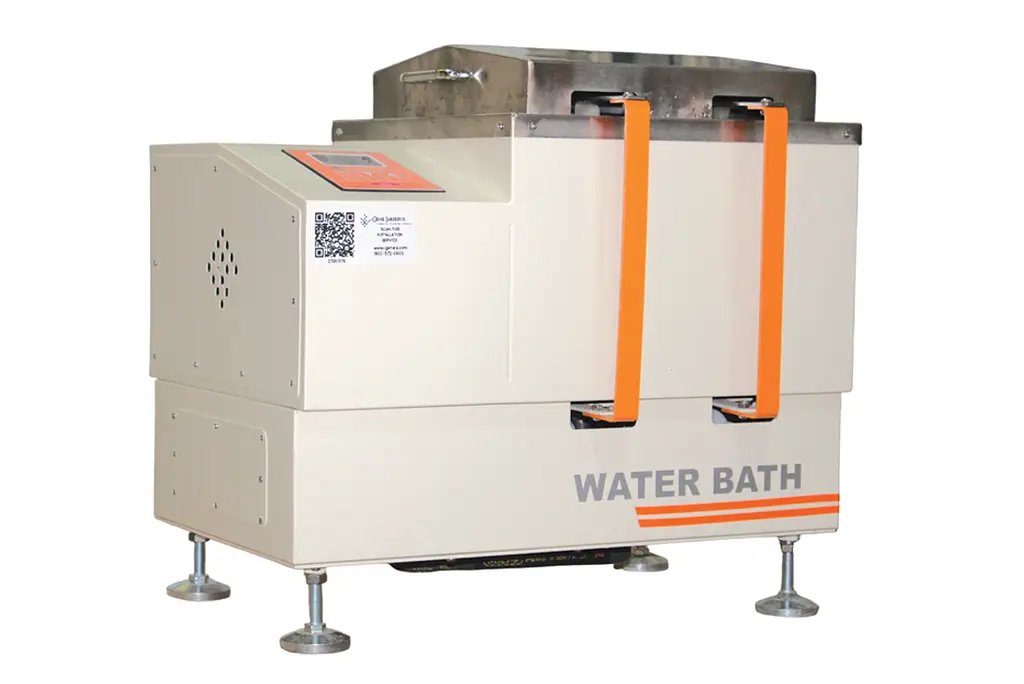
A laboratory needs to use a shaking water bath instead of an orbital shaker when experiments require precise temperature control and gentle agitation. It is ideal for incubation, thawing, hybridization, and enzymatic reactions where maintaining uniform heat is critical. Orbital shakers are better suited for mixing samples at room temperature without strict thermal requirements.
Difference between Shaking Water Bath and Orbital Shaker
A laboratory shaking water bath as well as an orbital shaker provides agitation but they serve different purposes.
Shaking Water Bath
- Provides controlled heating and uniform temperature distribution
- Submerges samples in heated water
- Offers gentle shaking motion
- Ideal for temperature-sensitive procedures
Orbital Shakers
- Agitate samples using circular motion
- Typically operate at ambient or incubator temperatures
- Suitable for mixing, aeration, and culture growth
- No direct water-based heating
When to Choose a Shaking Water Bath?
A water bath shaker becomes the preferred choice when a fine blend of temperature stability and gentle agitation is needed.
1. Enzyme Reactions & Biochemical Assays
Many enzymatic reactions require stable temperatures to maintain reaction kinetics. A shaking water bath ensures consistent thermal conditions and prevents localized overheating.
2. Cell Culture Incubation
For certain microbiological or cell culture applications, uniform heat and gentle motion promote even nutrient distribution and optimal growth.
3. Sample Thawing and Warming
Biological samples, reagents, and media require controlled thawing. A shaking bath accelerates thawing while preventing temperature shock.
4. Hybridization & Molecular Biology Procedures
5. Dissolving Reagents & Media Preparation
Heat combined with gentle shaking helps dissolve powders and reagents more efficiently than static heating.
When is Using Orbital Shaker Appropriate?
Despite their versatility, shaking water baths are not always necessary. So, you can choose an orbital shaker when:
- Temperature control is not required
- High-speed mixing or aeration is needed
- Working with flasks for microbial growth
- Performing staining or washing procedures
Orbital shakers are widely used for bacterial culture growth and general mixing tasks.
Advantages and Best Practices of Shaking Water Baths
Advantages
- Precise and uniform temperature control
- Gentle agitation reduces sample stress
- Prevents overheating and hot spots
- Improves reaction consistency
- Ideal for sensitive biological samples
Best Practices
Here is how to maximize performance and safety:
- Maintain proper water levels for uniform heating
- Use distilled water to prevent mineral buildup
- Regularly clean and disinfect to avoid contamination
- Monitor temperature calibration periodically
- Secure vessels properly to prevent tipping
Conclusion
A shaking water bath is essential when laboratory workflows demand simultaneous temperature control and gentle agitation. Orbital shakers remain valuable for general mixing and culture growth, but when thermal precision matters, a shaking water bath is the superior choice.
Ensure accurate temperature control and reliable sample agitation with high-performance laboratory equipment from iGene Labserve. Visit https://www.igenels.com/ to enhance the accuracy of your experiments.
Frequently Asked Questions
It provides uniform heating with gentle agitation, ensuring consistent reaction conditions.
Yes, only when temperature control is required; otherwise, orbital shakers are more suitable.
Most shaking water baths operate from ambient temperature up to approximately 100°C.
It prevents sample damage while ensuring uniform mixing and temperature exposure.