Table of Contents
Sonication plays a crucial role in modern laboratories and industrial processing, allowing researchers and professionals achieve efficient sample preparation, mixing, emulsification, and particle dispersion. When choosing the right ultrasonic equipment, the commonest comparison is probe sonicator vs bath sonicator. While both devices use ultrasonic waves, the intensity levels, working principles, and applications are entirely different. Understanding these differences can help you pick the right solution for your laboratory and industrial needs.
What is Sonication?
Sonication is the process of using high-frequency ultrasonic waves to agitate the particles within a sample. These sound waves create microscopic bubbles that collapse quickly, producing energy that is capable of breaking cells, dispersing nanoparticles, homogenizing solutions and cleaning laboratory equipment. The process is widely used in:
- Biotechnology and pharmaceuticals
- Chemical laboratories
- Food and beverage industries
- Nanotechnology research
- Material science applications
Based on the applications, laboratories decide which sonicator is better for labs.
What is Probe Sonicator?
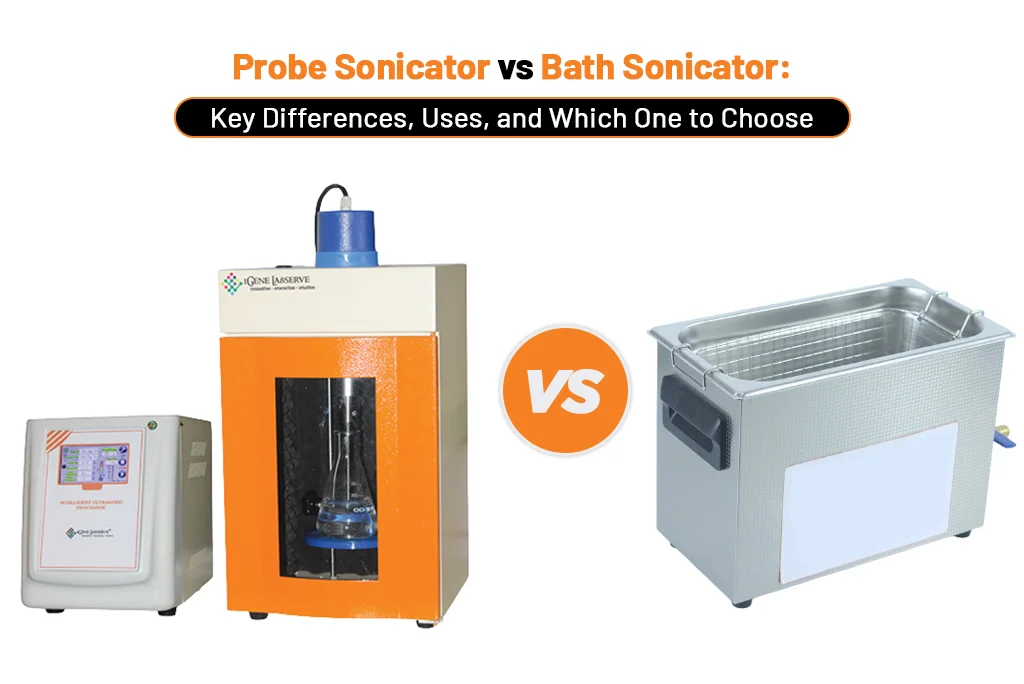
A probe sonicator is a high-intensity electronic device that transfers energy directly into the sample through a metal probe or horn. With this direct contact method, you can get concentrated ultrasonic energy for fast and efficient processing. Here are the key features of probe sonicators:
- Direct ultrasonic energy transfer
- High-intensity processing
- Faster sample treatment
- Precise control over amplitude and time
- Suitable for small to medium sample volumes
- Advanced safety features
- Flexible operation modes
- Comprehensive Display Functions
Due to their strong energy output, probe sonicators are ideal for demanding laboratory applications that require speed and precision.
What is a Bath Sonicator?
A bath sonicator or an ultrasonic bath uses indirect sonication where samples are placed inside containers within a water-filled chamber and ultrasonic waves are evenly distributed throughout the bath.
Key Features of Bath Sonicators:
- Gentle and uniform sonication
- Easy operation
- Ability to process multiple samples at once
- Lower contamination risk
- Lower intensity compared to probe sonicators
Common Applications of Bath Sonicators
Bath sonicators are widely used for:
- Cleaning laboratory instruments
- Degassing liquids
- Dissolving compounds
- Gentle sample mixing
- Removing contaminants from surfaces
They are preferred when delicate handling and uniform treatment are more important than high power intensity.
Differences Between Probe and Bath Sonicator
| Feature | Probe Sonicator | Bath Sonicator |
| Energy Delivery | Direct | Indirect |
| Intensity | High | Moderate |
| Processing Speed | Faster | Slower |
| Precision | High | Moderate |
| Sample Capacity | Small to medium | Multiple samples |
| Contamination Risk | Higher | Lower |
| Noise Level | Higher | Lower |
The difference between probe and bath sonicator lies in the way ultrasonic energy is delivered. While probe sonicators provide concentrated energy for rapid processing, bath sonicators offer gentler and more uniform sonication.
Pros and Cons of Probe Sonicators
Pros:
High-Efficiency Processing
Probe sonicators deliver powerful ultrasonic energy directly into the sample, making them highly effective for tough applications.
Faster Results
Due to their high intensity, probe sonicators reduce processing time significantly.
Better Precision
Researchers can control amplitude, pulse settings, and processing duration for accurate results.
Ideal for Cell Disruption
Probe sonicators are particularly effective for breaking down cells and dispersing nanoparticles.
Cons:
Despite their efficiency, probe sonicators have some drawbacks:
- Heat generation during processing
- Potential sample contamination from the probe
- Higher noise levels
- Probe sonicators Requires careful handling and maintenance
Pros and Cons of Bath Sonicators
Pros:
User-Friendly Operation
Bath sonicators are simple to operate and require minimal technical expertise.
Suitable for Delicate Samples
Their gentle ultrasonic action reduces the risk of damaging sensitive materials.
Multiple Sample Processing
Bath sonicators can process several samples simultaneously, improving workflow efficiency.
Lower Maintenance
Since the sample does not directly contact the ultrasonic source, wear and contamination risks are lower.
Cons:
Bath sonicators also have certain limitations:
- Lower ultrasonic intensity
- Less effective for cell lysis
- Longer processing time
- Limited precision compared to probe systems
How to Choose between a Probe and Bath Sonicator?
The right choice depends entirely on your application requirements.
Choose a Probe Sonicator if:
- You require high-intensity ultrasonic processing
- Your work involves cell disruption or nanoparticle dispersion
- Speed and precision are critical
Choose a Bath Sonicator if:
- You need gentle and uniform sonication
- You need to process multiple samples simultaneously
- Your primary applications involve cleaning or degassing
For advanced research and industrial applications, many laboratories use both systems for different purposes.
Conclusion
Choosing the right sonicator depends on your laboratory goals, sample type, processing intensity, and workflow requirements. By understanding the strengths and limitations of both, researchers and industries can select the most efficient solution for their applications. Upgrade your laboratory workflow with advanced sonication solutions from iGene Labserve designed for precision, efficiency, and reliable research outcomes across diverse laboratory and industrial applications. Visit https://www.igenels.com/ to explore our lab equipment.
Frequently Asked Questions
A probe sonicator delivers ultrasonic energy directly into the sample through a probe, providing high-intensity processing. A bath sonicator uses indirect ultrasonic waves through a water bath, offering gentler and more uniform sonication.
Probe sonicators are generally better for cell disruption and lysis because they provide concentrated ultrasonic energy that can efficiently break down cells and tissues.
Yes, bath sonicators are widely used for cleaning laboratory instruments, glassware, and delicate equipment by removing contaminants through ultrasonic vibrations.
Yes, probe sonicators typically process samples faster because they transfer ultrasonic energy directly into the sample with higher intensity.
The right choice depends on your application requirements. Probe sonicators are ideal for high-intensity tasks like homogenization and nanoparticle dispersion, while bath sonicators are better for gentle cleaning, degassing, and handling multiple samples simultaneously.