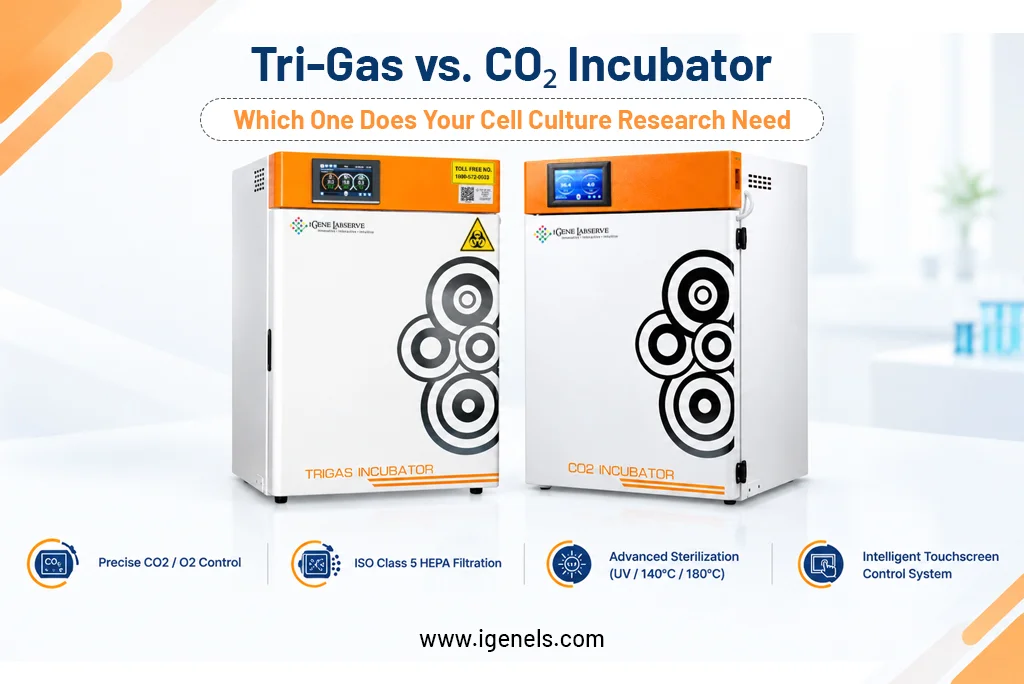
Choosing the right incubator can make a real difference to your cell culture research. While a standard CO₂ incubator meets the needs of many laboratories, some experiments require more precise control over oxygen levels. This is where a tri-gas incubator becomes more useful.
Understanding the difference between a tri-gas incubator vs. CO2 incubator can help you select equipment that matches your cell type, experimental protocol, and research objectives. Instead of investing in features you may not need, it is worth understanding how both systems work and when additional oxygen control is necessary.
What is the Difference between a Tri-Gas and CO2 Incubator?
What is the difference between a tri-gas and CO2 incubator? The main difference lies in oxygen control. A standard CO₂ incubator maintains temperature, humidity, and CO₂ levels for routine cell culture.
A tri-gas incubator typically provides additional control over oxygen concentration, making it suitable for hypoxic cell culture and other oxygen-sensitive experiments. If your research requires specific oxygen levels, a tri-gas model may be the better choice. For routine cell culture that does not require oxygen regulation, a conventional CO₂ incubator is often sufficient.
CO2 Incubator and Its Uses
A CO2 incubator provides a controlled environment for growing and maintaining cells under laboratory conditions.
What is CO2 incubator used for? It helps researchers maintain consistent temperature, humidity, and carbon dioxide levels, creating conditions suitable for many common cell culture applications.
How a CO2 Incubator Supports Cell Growth?
Most mammalian cells require carefully maintained environmental conditions to grow as expected in culture. Here is how a CO2 incubator helps:
- It helps maintain a temperature close to 37°C for mammalian cell culture, along with humidity to reduce evaporation from culture media. Carbon dioxide also plays an important role.
- In bicarbonate-buffered culture media, the CO2 concentration helps regulate pH. Maintaining appropriate balance supports stable culture conditions and helps researchers follow established experimental protocols.
The required settings depend on the cell type, culture medium, and laboratory procedure.
Common Applications of CO2 Incubator
A CO2 incubator is widely used for:
- Routine mammalian cell culture and cell line maintenance.
- Tissue culture and biomedical research.
- Cell-based assays and laboratory experiments.
- Research in academic institutions, biotechnology companies, and pharmaceutical laboratories.
For laboratories performing routine cell culture without specialized oxygen requirements, a CO2 incubator can provide the essential environmental controls needed for everyday research.
What is a Tri-Gas Incubator?
A tri-gas incubator is designed to provide additional control over the gaseous environment inside the chamber. It typically regulates oxygen and carbon dioxide concentrations, with nitrogen commonly used to adjust oxygen levels. Temperature and humidity are also controlled according to the model’s specifications.
This additional control makes a tri-gas incubator for cell culture particularly useful when researchers need to recreate oxygen conditions that differ from those found in normal atmospheric environments.
How Oxygen Control Changes Cell Culture Conditions?
Oxygen availability can influence cellular metabolism, gene expression, growth, and other biological processes. Standard laboratory conditions may not accurately represent the environment researchers want to investigate.
A tri-gas incubator for cell culture allows oxygen concentrations to be adjusted within the equipment’s specified range. For example, researchers can establish reduced-oxygen conditions to study how cells respond to hypoxia. The ability to control oxygen levels helps researchers maintain more consistent experimental conditions when oxygen concentration is an important variable.
Common Applications of Tri-Gas Incubators
Tri-gas incubators are used in specialized research areas, including:
- Cancer biology and tumor microenvironment studies.
- Stem cell research involving defined oxygen conditions.
- Hypoxia-related cellular studies.
- Research investigating cellular metabolism and oxygen-dependent responses.
However, not every laboratory needs these additional controls. The decision should depend on the experimental requirements rather than the assumption that more advanced equipment will automatically produce better results.
Tri-Gas Incubator vs. CO2 Incubator: Key Differences
When it comes to tri-gas incubator vs. CO2 incubator, the most important consideration is whether your experiments require controlled oxygen concentrations.
| Comparison Factor | CO2 Incubator | Tri-Gas Incubator |
| Primary purpose | Routine cell culture | Cell culture requiring additional gas control |
| Gas regulation | Typically controls CO₂ | Typically controls CO₂ and oxygen |
| Oxygen control | Usually ambient oxygen unless additional control is available | Adjustable oxygen concentration within the specified range |
| Typical applications | Routine mammalian cell culture and cell line maintenance | Hypoxia research and other oxygen-sensitive experiments |
| Experimental requirements | Suitable for standard culture protocols | Useful for protocols specifying controlled oxygen levels |
| Equipment considerations | Often a practical choice for routine applications | May involve additional costs, gas consumption, and calibration requirements |
Both types of incubators can provide controlled conditions for cell culture, but they serve different experimental needs.
When is a Tri-Gas Incubator Needed?
A tri-gas incubator may be needed when your research protocol requires oxygen concentrations that cannot be maintained using a conventional incubator. Do I need a tri-gas incubator for hypoxic cell culture?
Yes, a tri-gas incubator is a suitable option for hypoxic cell culture when experiments require controlled oxygen levels over an extended period. Its integrated gas regulation can help researchers maintain the desired environment without relying on repeated manual adjustments. However, the right system is the one that reliably meets your experimental requirements.
Conclusion
The choice between a tri-gas incubator and a CO₂ incubator ultimately depends on the conditions your research requires. A CO₂ incubator is a practical option for many routine cell culture applications, while a tri-gas incubator is worth considering when precise oxygen regulation is essential.
Looking for the right incubation equipment for your research? iGene Labserve, your trusted lab equipment supplier, can help you explore laboratory solutions suited to your cell culture requirements. Visit https://www.igenels.com/ to find the right laboratory equipment.
Frequently Asked Question
A CO₂ incubator typically controls temperature, humidity, and CO₂ levels for routine cell culture. A tri-gas incubator generally adds oxygen control, allowing researchers to establish specific oxygen conditions for hypoxia studies and other specialized experiments.
A tri-gas incubator is one suitable option for maintaining controlled oxygen conditions. Depending on the protocol, a specialised hypoxia chamber or another validated system may also meet the requirements.
A CO₂ incubator is used to grow and maintain cells under controlled temperature, humidity, and carbon dioxide conditions. Common applications include routine mammalian cell culture, cell line maintenance, tissue culture, and biomedical research.