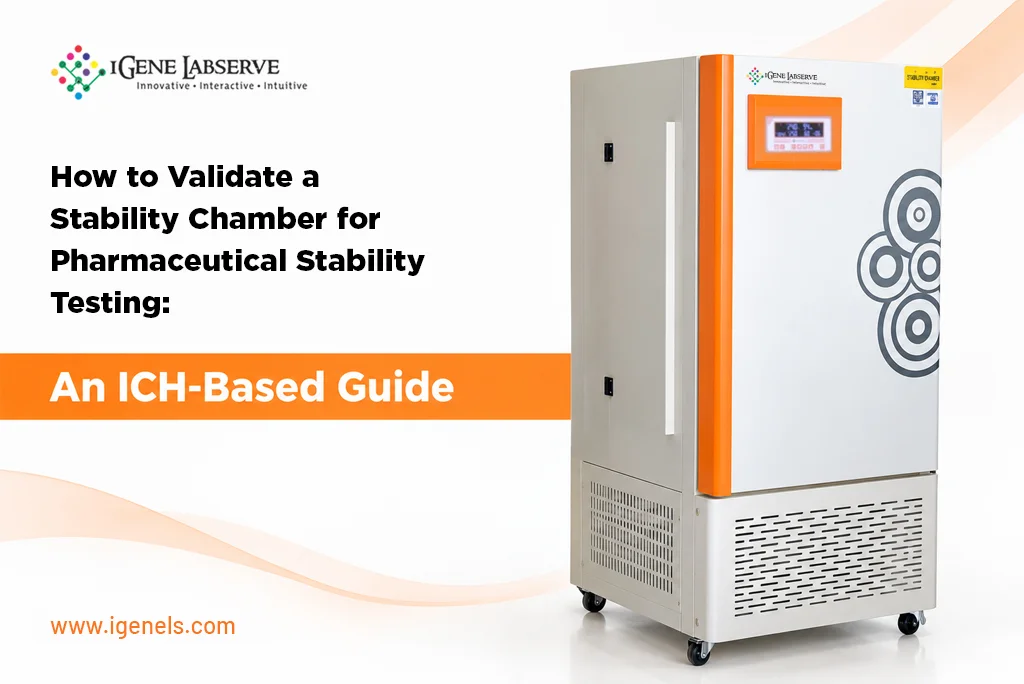
Pharmaceutical stability testing is based on one basic requirement that is maintaining products under controlled environmental conditions for a defined period. If temperature or humidity fluctuates beyond acceptable limits within that period, the reliability of the stability data can be affected.
This is when the stability chamber validation ICH requirements and proper equipment qualification play a crucial role. A qualified chamber provides documented evidence that the required environmental conditions can be maintained consistently throughout a stability study.
What is Stability Chamber Validation?
Stability chamber validation is the documented process of demonstrating that a chamber can maintain specified temperature and humidity conditions within the acceptance criteria.
For stability chambers, qualification typically includes Installation Qualification (IQ), Operational Qualification (OQ), and Performance Qualification (PQ), supported by calibration, monitoring and temperature-humidity mapping.
ICH Q1A Stability Testing Requirements
ICH Q1A (R2) establishes important expectations for stability testing of new drug substances and drug products. It defines stability study conditions, testing approaches and considerations for evaluating changes in product quality over time.
However, it is not a detailed pharmaceutical stability chamber validation procedure. The guideline establishes expectations for stability studies, while equipment qualification and mapping provide evidence that the chamber can reliably maintain the conditions required for those studies.
Overall, the chamber should be capable of controlling the required environmental conditions, and actual temperature and humidity conditions should be monitored during stability storage.
How to Validate Stability Chamber?
Understanding how to validate a stability chamber starts with defining what the chamber is expected to achieve. A systematic chamber qualification process generally includes the following steps.
1. Define the User Requirement Specification
The process begins with a clear User Requirement Specification (URS). This should establish the intended use and performance requirements of the chamber.
Important parameters may include:
- Required temperature range
- Required relative humidity range
- Chamber capacity
- Intended stability conditions
- Monitoring requirements
- Alarm functions
- Data recording and storage
- Applicable regulatory and quality requirements
A well-defined URS provides the foundation for the subsequent qualification activities.
2. Perform Installation Qualification
The chamber needs to be installed based on stability chamber qualification protocol, including manufacturer’s requirements.
At this stage, the verification includes the following:
- Equipment identification and specifications
- Physical installation
- Utilities and connections
- Sensors and measuring instruments
- Calibration certificates
- Operating manuals and documentation
Any deviations identified during installation should be documented and assessed before proceeding.
3. Perform Operational Qualification
Operational Qualification determines whether the chamber operates correctly across its specified operating range.
Testing may cover temperature and humidity control, alarms, monitoring systems and door-opening recovery. The objective is to demonstrate that the chamber responds appropriately to operating changes and maintains the required conditions.
4. Conduct and Humidity Mapping
Temperature humidity mapping is a critical part of chamber qualification.
Multiple calibrated sensors are positioned at defined locations throughout the chamber to identify potential temperature and humidity variations. Mapping can reveal hot spots, cold spots or areas where humidity differs from the desired range.
The results can then help determine suitable locations for routine monitoring sensors and establish whether the chamber provides adequate environmental uniformity. Mapping should be performed under conditions representative of the chamber’s intended operation, with the methodology, sensor locations, and duration and acceptance criteria defined in advance.
5. Perform Qualification
Performance Qualification demonstrates that the chamber can consistently perform under actual or representative conditions of intended use.
This may involve representative loading and routine operating conditions. Temperature and humidity stability, recovery after door opening, monitoring performance and other predefined parameters can be evaluated.
Successful PQ provides greater confidence that the chamber is suitable for ongoing pharmaceutical stability testing.
Key Tests in Stability Chamber Validation
Several tests may be used during pharmaceutical stability chamber validation, depending on the equipment, intended use and qualification strategy.
| Test | What it Demonstrates |
| Temperature uniformity | Consistency of temperature throughout the chamber |
| Temperature stability | Ability to maintain the required setpoint over time |
| Humidity uniformity | Consistency of RH distribution |
| Humidity stability | Ability to maintain target RH |
| Temperature/RH mapping | Identifies environmental variations within the chamber |
| Recovery test | Ability to return to required conditions after door opening |
| Alarm verification | Confirms that alarms respond to defined deviations |
| Sensor calibration | Confirms measurement accuracy |
How Stability Chamber Validation Supports Accelerated Stability Studies?
Accelerated stability studies expose pharmaceutical products to elevated environmental conditions to generate stability information over a shorter period.
Because these studies rely on controlled temperature and, where applicable, humidity, chamber performance is particularly important. A qualified chamber helps ensure that the intended study conditions are maintained consistently.
If significant deviations occur, the resulting data may require assessment before conclusions about product stability can be made.
Conclusion
A stability chamber is more than a temperature- and humidity-controlled enclosure. Its performance directly supports the reliability of pharmaceutical stability studies. When supported by appropriate procedures and documentation, proper stability chamber validation ICH practices provide a stronger foundation for dependable pharmaceutical stability testing.
Are you searching for the right equipment for your laboratory? From stability chambers to biosafety cabinets and other specialized laboratory solutions, iGene Labserve combines dependable equipment designed to support demanding research, testing and pharmaceutical applications. Visit iGene Labserve to explore our products.
Frequently Asked Questions
Stability chamber validation demonstrates, through documented testing, that a chamber can consistently maintain the environmental conditions required for its intended pharmaceutical stability studies.
The process generally involves defining requirements, completing IQ, OQ and PQ, verifying calibration, conducting temperature and humidity mapping, testing alarms and documenting results against predefined acceptance criteria.
Temperature and humidity mapping involves placing calibrated sensors at defined locations throughout a chamber to evaluate environmental uniformity and identify areas with significant temperature or humidity variation.
A qualification protocol generally includes the scope, equipment details, test methodology, sensor locations, acceptance criteria, calibration requirements, mapping procedures, alarm testing, deviation handling and approval requirements.
Chamber qualification provides documented evidence that the equipment can maintain the required conditions consistently, helping ensure that stability data is generated under controlled and reproducible environmental conditions.