
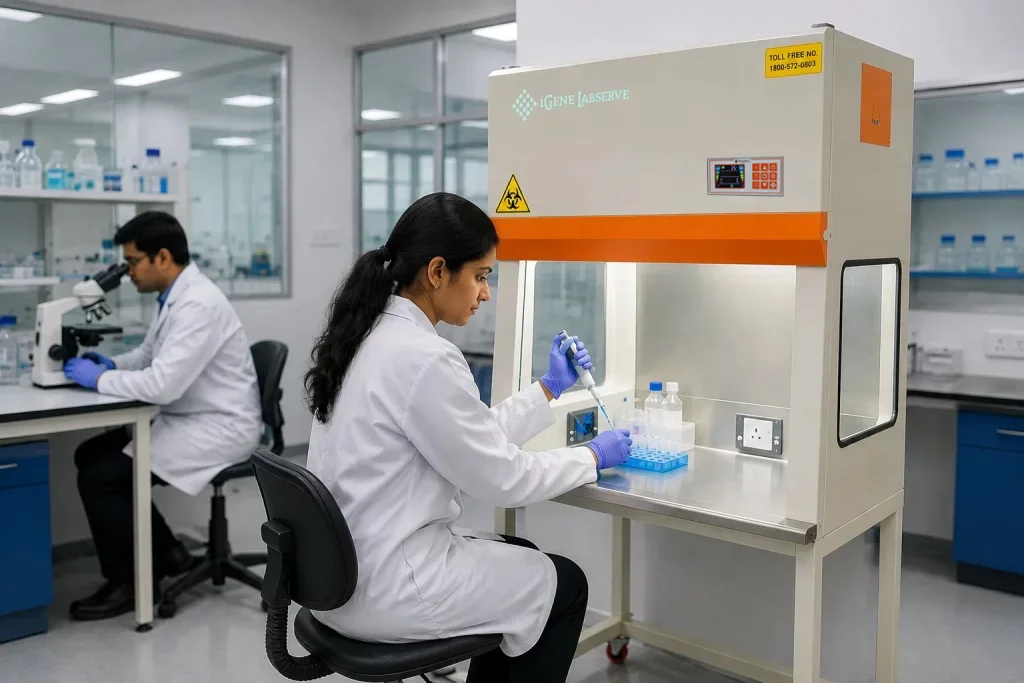
A PCR workstation is not legally mandatory for NABL-accredited laboratories. However, it is highly recommended for labs performing PCR-based molecular testing. According to guidelines of NABL and ISO15189, laboratories need to maintain contamination-controlled environments for molecular diagnostics. A PCR workstation NABL help meet these conditions, making it an important component in many in several NABL-compliant molecular laboratories.
Table of Contents
Understanding NABL Accreditation Requirements
The National Accreditation Board for Testing and Calibration Laboratories or NABL provides accreditation to testing and calibration laboratories in India based on international quality standards. Medical laboratories typically follow ISO 15189, which emphasizes:
- Reliable test results
- Controlled laboratory environments
- Proper equipment and infrastructure
- Prevention of contamination during testing
For laboratories performing molecular diagnostics such as PCR, maintaining strict contamination control is essential because even tiny traces of amplified DNA can lead to false positive results.
Why PCR Workstations are Common in NABL-Accredited Labs?
- HEPA filtration to remove airborne contaminants
- UV sterilization to eliminate DNA contamination
- Enclosed workspace to minimize external exposure
When is a PCR Workstation is Essential?
Even if not strictly mandatory in that way, a PCR workstation is practically necessary when laboratories:
- Perform high-throughput PCR testing
- Conduct clinical molecular diagnostics
- Handle infectious disease detection (e.g., viral RNA testing)
- Need to demonstrate strong contamination control during NABL audits
In these scenarios, inspectors often expect laboratories to show dedicated PCR preparation infrastructure, and PCR workstations are commonly used to meet this requirement.
Benefits of Using PCR Workstation in Accredited Laboratories
PCR workstations help laboratories achieve compliance and maintain reliable results by providing:
- Improved sample integrity
- Reduced cross-contamination risk
- Better audit readiness for accreditation
- Enhanced workflow efficiency in molecular labs
These advantages make PCR workstations a standard feature in many NABL-accredited molecular diagnostic laboratories.
Conclusion
A PCR workstation may not be explicitly listed as mandatory by the National Accreditation Board for Testing and Calibration Laboratories but they are widely used and often considered essential equipment for NABL-accredited molecular laboratories.
Essential equipment for NABL-accredited molecular laboratories. Quip your lab with trusted molecular biology equipment from IGene Labserve. Visit http://igenels.com/ for advanced PCR laboratory solutions.
FAQs
1. Is a PCR Workstation mandatory for NABL-accredited labs?
A PCR Workstation is not strictly mandatory under guidelines from the National
Accreditation Board for Testing and Calibration Laboratories, but it is highly
recommended for laboratories performing PCR testing to maintain contamination control and ensure reliable results.
2. Why do molecular laboratories use PCR Workstations?
PCR Workstations provide a sterile environment with HEPA filtration and UV
sterilization, helping laboratories prevent DNA contamination during PCR sample
preparation.
3. What equipment is commonly used in a PCR laboratory?
Common PCR laboratory equipment includes a PCR Workstation, Gel Documentation System, Vertical Gel Electrophoresis System, and Electrophoresis Power Supply, which support DNA amplification, separation, and analysis.
4. What is the purpose of a Gel Documentation System?
A Gel Documentation System is used to visualize and capture images of DNA or
RNA bands after gel electrophoresis, allowing researchers to analyze PCR
results accurately.
5. Why is an Electrophoresis Power Supply important in PCR labs?
An Electrophoresis Power Supply delivers controlled voltage and current needed
to run electrophoresis experiments, ensuring consistent separation of DNA
fragments during analysis.